
If a door closer closes too fast, too slowly or does not latch, adjusting its valves is almost always enough. It needs replacing when it leaks oil, when the arm is broken or when its strength does not suit the weight and width of the door.
What exactly does a door closer do?
A door closer (in Spain, cierrapuertas or muelle hidráulico) is the metal box with an arm fitted at the top of the door. Inside there is a spring that pushes the door shut and an oil circuit that slows that movement down so the door does not slam.
It is a small part, but it does three jobs at once:
- It closes the door by itself, even when a neighbour lets go of it without looking.
- It controls the speed so the door does not hit the frame or whoever is walking through.
- It gives the final push so the latch engages in the lock and the door is properly shut.
In an apartment building, the entrance door opens and closes hundreds of times a day. That makes its door closer one of the hardest-working parts in the whole building, and one of the first to wear out.
Signs that something is wrong
- The door slams: it closes too fast or bangs at the end.
- The door stays open or stops a few centimetres short of the frame.
- The door closes but the latch does not engage, so a simple push opens it.
- There are oil stains on the box, on the arm or on the floor under the door.
- The arm is noisy, loose or bent.
- The door is very hard to open, especially for children and older people.
The first three are usually a matter of adjustment. The last three usually mean the closer is worn out or is not the right one for that door.
When adjusting it is enough
Most door closers have two or three adjustment screws (valves) on one side of the box:
- Closing speed: controls how fast the door moves through the first part of its swing.
- Latching speed: controls the last stretch, the one that makes the latch engage in the lock.
- Back check (on some models): stops the door flying open in the wind and hitting the wall.
With fine adjustment of these valves, a door that slammed can close gently again and a door that stayed open can latch again. Sometimes the strike plate (the plate on the frame where the latch goes in) also needs moving, or the hinges need adjusting, because if the door has dropped no closer will shut it properly.
One tip: turn the valves a little at a time, a quarter turn at most. If they are loosened too far, oil can leak out and the closer is ruined.
When it has to be replaced
Adjusting will not help in these cases:
- It leaks oil. Without oil there is no braking: the door slams however much you turn the valves. It cannot be repaired, it has to be replaced.
- The arm is broken or bent, or the fixings have come loose from the frame.
- It is too weak for the door. This is very common with the heavy iron-and-glass entrance doors of Málaga's apartment blocks: the closer simply cannot pull them shut.
- It is too strong. The door is hard to open and the mechanism suffers every time it closes.
- It is many years old and has already been adjusted several times without holding.
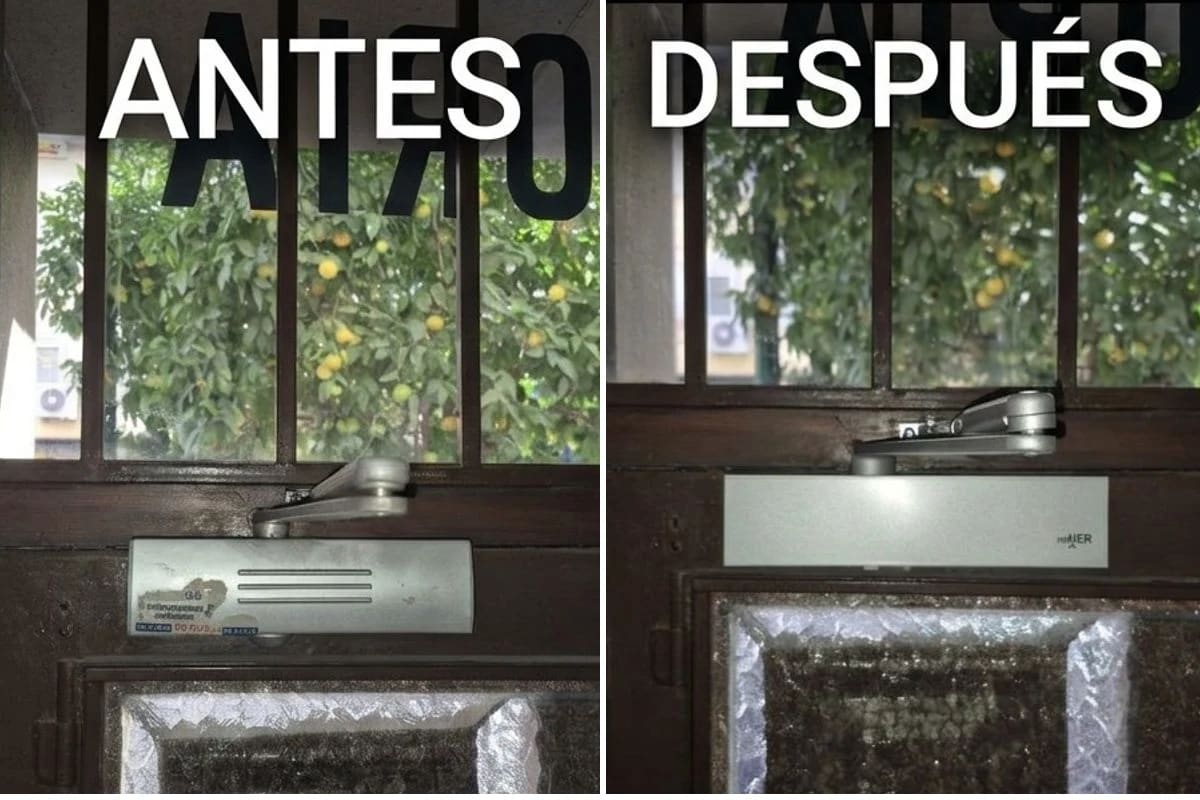
That is what happened on the job in the photo: the building's old door closer no longer slowed the door down. We replaced it with a new one, adjusted it to suit the door, and the door went back to closing by itself, without slamming.
How to choose the closing force
Door closers are graded by closing force, from EN 1 to EN 7, according to the width and weight of the door. As a guide:
| Force | Door width | Approximate weight |
|---|---|---|
| EN 2 | Up to 85 cm | Up to 40 kg |
| EN 3 | Up to 95 cm | Up to 60 kg |
| EN 4 | Up to 110 cm | Up to 80 kg |
| EN 5 | Up to 125 cm | Up to 100 kg |
| EN 6 | Up to 140 cm | Up to 120 kg |
Many models have adjustable force (for example, EN 2 to EN 5), so they can be matched to the exact door. For entrance doors exposed to wind or strong draughts, it is worth going one step up in force.
The type of arm matters too: the scissor arm (the classic one, with two jointed pieces) gives more force, while the slide arm (a straight track) is more discreet and common in offices and shops.
Door closers in residential buildings
The entrance door closer is a shared element, so repairing or replacing it is paid for by the residents' association (comunidad de vecinos). The usual route is to let the president or the property manager know, and they ask us for a quote.
It is not worth waiting for the next residents' meeting: an entrance door that does not close lets anyone in as far as the landings, storage rooms and meter rooms. And a door that slams ends up breaking the lock, the strike plate and even the glass. If the problem is not just the door closer, we explain everything in building entrance door will not close.
Need a door closer adjusted or replaced in Málaga?
At AYG Cerrajeros we adjust and replace door closers on building entrances, garages, offices and shops all over Málaga: Carretera de Cádiz, Cruz de Humilladero, Huelin, Teatinos and every other neighbourhood, as well as Rincón de la Victoria, Torremolinos, Alhaurín de la Torre and Cártama. Send us a photo of the door closer and the door on WhatsApp and we will tell you whether adjusting it is enough or it needs replacing, with the price before we come out. There is more information on our locksmith for residential buildings page.
Frequently asked questions
Why does the building entrance door slam?
Almost always because the door closer is badly adjusted or has lost oil. If it is set too fast, the closing speed is adjusted; if it leaks oil, it has to be replaced.
Can I adjust a door closer myself?
You can, but carefully: turn the valves only a little at a time. If they are loosened too far, the oil leaks out and the closer is ruined. On a shared building door it is better left to a professional.
How long does a door closer last?
It depends on use and quality. On a busy entrance door, a good closer of the right strength lasts many years; one that is too weak for the door wears out much sooner.
Who pays for the building door closer?
The residents' association, because it is a shared element. It is usually handled by the president or the property manager.
How much does it cost to replace a door closer?
It depends on the force and type of closer the door needs. Send us a photo on WhatsApp and we will give you a fixed price before we start.
Related services
Locksmith for residential buildings
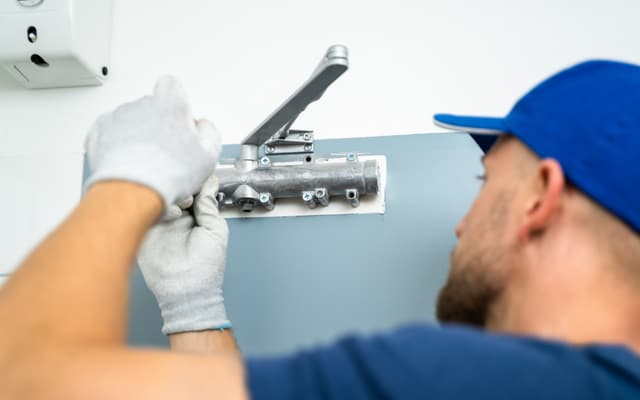
We repair building entrance doors, change lock cylinders in shared areas and set up master key systems for communities of owners in Málaga.
From €70View service →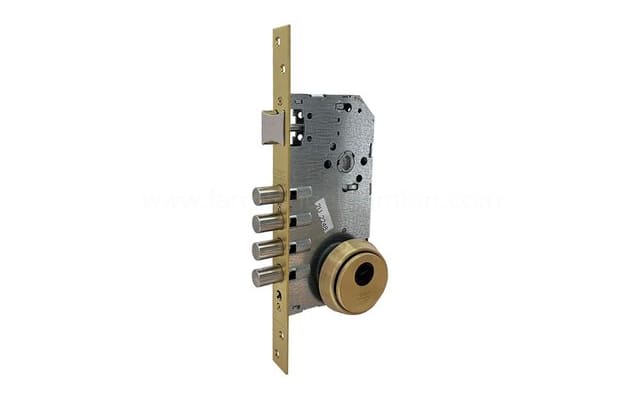
Lock change
We change mortice and multipoint locks, security door locks, metal shutter locks and building entrance door locks throughout Málaga city.
From €80View service →